



How to choose school tablet charging cabinet supplier?
 Nov 06, 2026|
 View:21
A secure device charging cabinet for schools is one of the few purchases an IT department makes that is judged every single day—by teachers who need devices charged by first period, by students who return them five times a day, and by the finance office that sees the invoice once. Buy the wrong unit and you will hear about it by October; buy from the wrong source and you will still be hearing about it in year three. That is why the decision is less about which steel box looks best and more about which school tablet charging cabinet supplier can still answer the phone in year three.
This guide walks through the decision in the order a procurement team actually meets it: form factor, capacity, charging architecture, safety, factory verification, total cost of ownership, and the red flags that should end a negotiation. Whether you are buying one classroom tablet charging cart or rolling out a district-wide school device charging solution, the checklist is the same.
Start With the Deployment, Not the Catalog
Suppliers who lead with a price list are selling you their bestseller. The correct starting point is where the devices live and who moves them:
Fixed rooms: a secure device charging cabinet for schools that stays in one classroom, anchored or wall-adjacent, is the cheapest per bay and the easiest to secure overnight
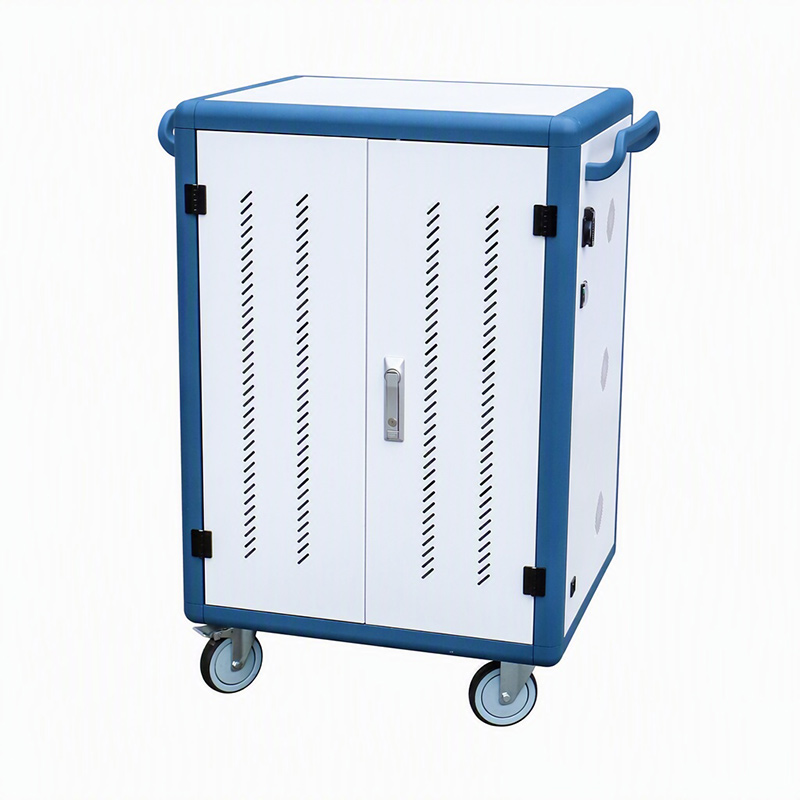
Shared rooms: a power charging trolley for school tablets that travels between classrooms needs braked casters, a balanced frame and a handle height teachers can actually push
One class set: a classroom tablet charging cart at 24–30 bays, plugged into a single wall outlet, is the workhorse of 1:1 programs
Mixed fleets: if laptops and tablets share the pool, a school laptop charging trolley with adjustable dividers serves both without a second purchase
Write the deployment description down before you request a quote. A school tablet charging cabinet supplier who asks for it unprompted has handled school projects before; a supplier who sends a price sheet instead has not.
Capacity: Match the Timetable, Not the Headline Number
Bay count is the first number on every quote and the last number that matters. What actually decides capacity is the charging window between periods:
| Deployment | Bays | Why |
|---|---|---|
| Single classroom set | 24–30 | One class plus spares; a 30-bay cart still fits a standard storeroom door |
| Shared department pool | 32–36 | Covers two overlapping classes without a second unit |
| Grade-level or district tender | 36–48 | Bulk pricing per bay improves; check crate size and assembly time |
| Overnight secure storage | 16–20 | A secure device charging cabinet for schools locked in a prep room, charged and accounted for by 07:30 |
Two details separate a school-grade unit from a generic one. First, numbered bays: in a 1:1 program, bay 14 belongs to student 14, and a missing tablet is visible at a glance rather than at the end of term. Second, bay pitch: a 10.9-inch tablet inside a rugged case needs 32–35mm, and a bay that is 2mm too narrow will reject every case on the market—a defect nobody notices until the first carton is opened on site.
If rooms are shared rather than owned, the same arithmetic favors a power charging trolley for school tablets: one 30-bay trolley serving three rooms beats three small secure device charging cabinets serving one, provided the casters and the frame are rated for the daily corridor run.
If the fleet mixes iPads and Chromebooks, ask whether the same chassis can be re-divided later. A school laptop charging trolley with a two-pitch divider set absorbs the next device refresh without a new purchase, which is the difference between a three-year product and a six-year one.
Charging Architecture: AC, USB-A or USB-C PD
The port decision outlives the device decision. A classroom device charging solution bought for today's tablets will still be charging their replacements in 2030, so specify the architecture, not the current model number.
AC direct: one socket per bay, devices use their own adapters. Highest wattage, simplest support, correct for mixed 65W+ fleets
USB-A: 5V/2.4A fixed, lowest cost, correct only for legacy tablets that will not be refreshed
USB-C PD: 45–65W per port, one cable type for every modern device, and the only option that survives a refresh without new tooling
Ask one question before any other: is the total PD budget shared across the secure device charging cabinet or dedicated per bay? A shared-budget unit charges two devices properly and twenty devices slowly, which looks like a broken product even when it is working to specification. A proper school device charging solution states the per-bay wattage and the total draw in writing.
Also ask about sequencing. Thirty devices starting at 08:00 will trip a 16A breaker in a room nobody surveyed; a unit with staged bank start-up is the reason your first morning is uneventful. If the supplier cannot explain their soft-start logic in two sentences, they have never shipped into a school.
Safety and the Documents Behind It
A school charging cabinet is an electrical appliance that children touch thirty times a day. Price-sensitive buyers compare dollars; school boards compare risk. Ask for:
CE-LVD / CE-EMC, RoHS, and UKCA or UL 62368-1 for the target market
Over-current, over-voltage, short-circuit, leakage and over-temperature protection
Flame-retardant (94V-0) dividers and a vented rear panel
Soft-start sequencing and a written load table
Lock: keyed cylinder with master-key option, or PIN/RFID where the site audits access
Anchoring kit included, not sold separately
Certificates are not paperwork—they are what lets the purchase survive a school board sign-off, an IT audit and an insurance review. A serious school tablet charging cabinet supplier sends the test reports with the quotation; a reseller sends them after you chase, if at all.
Six Questions That Separate a Factory From a Reseller
Most "suppliers" in this category are trading companies with a catalogue and a margin. Six questions sort them out in one email:
Can you send shop-floor video of the laser line, the coating booth and the burn-in rack? A factory sends it the same day.
Do the test reports name your company or a third party? Reports must be transferable to the buyer's tender file.
Is thesecure device charging cabinet sample built from the same port modules as production? Otherwise you approved hardware you will never receive.
What is the warranty split between structure and electronics? A 3-year body / 1-year electronics split is honest; "1 year everything" is not.
Which spare parts ship with the order? Cables, keys, casters and a lock cylinder are consumables in a school, not options.
Can you show a reference project of the same size? A school tablet charging cabinet supplier who has done a 40-unit district rollout will have photos, contacts and a reference letter ready.
A direct school tablet charging cabinet manufacturer will answer all six before you ask for a discount. That is the point of the exercise: you are not shopping for a cabinet, you are shortlisting a partner who can hold the specification across repeat orders.
Total Cost of Ownership Over Five Years
The invoice is the smallest line in the real cost of a classroom device charging solution. Budget the full five-year picture:
Failure cost: one dead bank of ports in a 30-bay unit takes a whole class offline; modular, field-replaceable power boards turn that from a two-week return into a ten-minute swap
Consumables: cables and keys disappear in schools; ask what a replacement cable set costs and whether it is stocked locally
Downtime: a power charging trolley for school tablets that cannot be pushed up a ramp, or a cabinet nobody has the key for, costs teaching time no warranty claim recovers
Refresh cost: a USB-A-only unit is scrap at the next device cycle; a USB-C PD unit survives it
Compare two quotes at the same bay count and the cheaper one usually wins the first year and loses the third. Schools that buy on five-year cost end up with fewer units, better uptime and a calmer IT calendar.
If the deployment is a phased school device charging solution—ten rooms this year, ten next year—confirm that the chassis, bay drawing and lock system stay identical across orders. Mixed generations of the same product are how spare-part inventories quietly double.
Red Flags When Comparing Quotes
No factory photos, no audit welcome, no third-party inspection offer
"Fast charge" claims on 5V/2A hardware
No electrical test report, or a report in someone else's name
Suspiciously low price with no spare-part list
Cannot name a single school or district reference
Quote changes every time you ask the same question—a supplier who cannot hold their own specification will not hold yours
Any one of these is a reason to slow down. Two together are a reason to walk away, however good the price looks in a spreadsheet.
Why Schools and Distributors Choose Lucktech Group
Lucktech Group passes the six-question test above because the answers are structural, not sales talk:
Direct manufacturer: 15,000 sqm Ningbo base with CNC laser cutting, robot welding, powder coating and 100% burn-in testing under one roof
20+ years export experience: 90+ countries served, 300+ global partners, education and enterprise projects from 10 units to full district rollouts
School-grade electricals: ten-fold protection (over-current, over-voltage, short-circuit, leakage, over-temperature), soft-start sequencing, CE/RoHS/UL-ready configurations
Full form-factor ladder: from 16-bay cabinets to 30-bay carts and 36–48-bay district units, on shared tooling
OEM/ODM for resellers: bay pitch, port mix, lock type, plug standard, colour, logo and packaging configurable; one chassis, several catalog SKUs
Tender-ready documentation: bay drawings, load tables, test reports and specification sheets delivered with the quotation, not after it
After-sales clarity: structure warranty plus electrical-parts support, field-replaceable power modules and a stocked spare-part kit
For a district planning a phased classroom device charging solution, the practical benefit is continuity: the same chassis, the same bay drawing and the same lock system across every order, so year-three units dock into the same workflow as year-one units.
Send Lucktech your device list, room plan and timetable window, and the reply is a specification with a load table—not a catalog page. That single difference is what a district-scale deployment is supposed to look like on paper before it looks good in a classroom.
FAQ
Q1: Cabinet, cart or trolley—which should a school buy first?
If devices stay in one room, buy a fixed charging cabinet for schools. If two or three rooms share a class set, buy a power charging trolley for school tablets with braked casters. The cabinet is cheaper per bay; the trolley multiplies utilization.
Q2: How many bays does a standard classroom need?
Most K12 classes run 25–30 students, so a 30-bay classroom tablet charging cart covers the set plus two spares. Departments sharing pools should look at 32–36 bays instead of buying two small units.
Q3: Is USB-C PD worth the premium for a school?
Almost always. A USB-C PD cabinet charges every modern tablet and Chromebook from one cable type and survives the next device refresh. USB-A-only hardware is a three-year purchase; PD is a six-year one. For any classroom device charging solution, PD also cuts adapter loss—the most-stolen item in any school—to zero.
Q4: What certifications should we require in the tender?
CE-LVD, CE-EMC and RoHS as a baseline; UKCA for the UK, UL 62368-1 for North America, plus a written load table and over-temperature protection. Insist the reports carry the buyer's or manufacturer's name, not a trading company's.
Q5: Can one unit handle both tablets and laptops?
Yes—if the bay pitch is adjustable. A school laptop charging trolley with a two-pitch divider set takes 11-inch tablets and 14-inch notebooks in the same frame, which is the cheapest way to absorb a fleet that is half-refreshed.
Q6: How do we verify a supplier is actually a factory?
Ask for shop-floor video, third-party audit reports and a reference project of the same size. A real manufacturer answers within a day because the evidence already exists.
Q7: What does a school device charging solution cost over five years?
Beyond the invoice: spare cables and keys, one or two power-module swaps, and the downtime in between. Modular electronics and stocked spares are what keep the five-year number flat instead of lumpy.
Q8: Can classrooms be phased rather than bought all at once?
Yes, and they should be. Order ten units this year and ten next year on the same chassis and lock system, and the second order plugs into the first without new training, new keys or a new spare-part list.
Final Word
Choosing a school tablet charging cabinet supplier is a five-year decision compressed into one quotation. Specify the deployment before the product, the architecture before the price, and the paperwork before the deposit. For mixed fleets, a school laptop charging trolley with adjustable dividers is usually a safer first purchase than two single-purpose units.
The shortlist rule is simple: any supplier who sends a load table, a bay drawing and a test report with the quote has already passed the tests that matter. Any supplier who sends a price first is selling you the cheapest part of the product.
Lucktech Group fits the first profile: a direct manufacturer with 20+ years of export experience, a 15,000 sqm production base, education-grade electricals and tender-ready documentation. Whether the project is a single classroom tablet charging cart, a school-wide rollout, or a district-scale programme, send the device list and the timetable, and the specification comes back the same week.
Ready to Equip Your Classrooms?
Get School Quote & Tender Support