



Tablet Charging Cabinet Manufacturer Supporting US/EU/UK/AU Plug
 Nov 27, 2026|
 View:6
Most export problems with a tablet charging cabinet do not start on the production line. They start on a purchase order that says "230 V, EU version" without naming a socket type, a cord length or an inlet, and they end with forty units standing in a school hall that cannot be plugged into the wall. A tablet charging cabinet manufacturer that ships to the United States, the European Union, the United Kingdom and Australia is not selling one product with four stickers. It is selling four electrical build variants that share a chassis.
This guide explains what changes between those variants, where the differences actually cost money, and which questions should be answered before tooling starts. It is written for distributors, tender resellers and facilities teams who need cabinets that pass inspection on arrival rather than after a second shipment of cords.
Key Takeaways
Pin shape is only the visible layer: mains voltage, frequency, inlet rating and cord length all change between US, EU, UK and AU builds.
A tablet charging cabinet manufacturer should be able to quote the socket standard, the inlet type and the marking on the rating label in writing, per destination market.
At 120 V a 30-bay cabinet draws roughly twice the current it draws at 230 V, so the US order needs a different circuit plan, not just a different plug.
Certification follows the destination: CE for the EU, UKCA for Great Britain, RCM for Australia, and a UL 62368-1 aligned design for North America.
Interchangeable inlet modules and documented cord sets turn four variants into one platform, which is what keeps spare-part costs and lead times predictable.
A tablet charging cabinet that is documented per market is cheaper to support than one that is customized per market.
Why Plug Standard Decides Export Readiness
Four plug families, one product line
A plug standard is a mechanical, electrical and legal specification at the same time. The pins must fit the socket, the insulation must suit the mains voltage, and the marking must satisfy the market's regulator. For a tablet charging cabinet this distinction shows up at the packing line rather than at the design table, which is why it is so often missed. The four families that matter are NEMA 5-15 in North America, CEE 7 variants across most of the EU, BS 1363 in the UK and Ireland, and AS/NZS 3112 in Australia and New Zealand.
| Plug family | Main markets | Typical rating | Design note |
|---|---|---|---|
| NEMA 5-15 | United States, Canada | 125 V, 15 A | Two flat pins plus earth; branch circuits are usually 120 V |
| CEE 7/3 and 7/7 | Germany, France, Netherlands, most EU states | 250 V, 16 A | Schuko and hybrid plugs coexist; socket depth varies by country |
| BS 1363 | United Kingdom, Ireland, parts of the Gulf | 250 V, 13 A | Fused plug; the fuse rating has to match the cabinet's load |
| AS/NZS 3112 | Australia, New Zealand | 250 V, 10 A | Insulated pins; socket outlets often include a switch |
Voltage and frequency matter as much as pin shape
North America runs at 120 V and 60 Hz; the EU, UK and Australia run at 230 V and 50 Hz. A switch-mode power supply inside a tablet charging cabinet usually accepts both, which is why a single electronics platform can serve all four markets. The parts that do not adapt are the inlet, the cord set, the fuse and the rating label, and those are exactly the parts an inspector looks at first.
Frequency tolerance is a smaller issue for chargers and a larger one for any cabinet that carries a fan, a timer or a monitoring board with a mains-referenced clock. A unit designed around 50 Hz will run on 60 Hz in most cases, but the supplier should confirm it in writing rather than leaving the buyer to test it in a classroom.
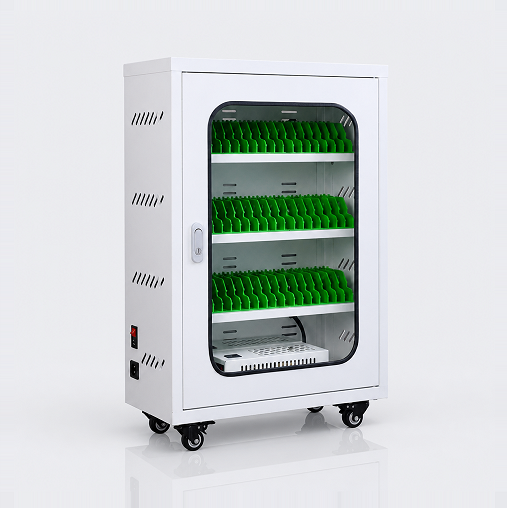
What a Tablet Charging Cabinet Manufacturer Should Lock Down Before Tooling
Inlet, harness and labeling
Most export cabinets use a detachable cord set into an IEC 60320 C14 inlet, rated 10 A at 250 V. That single decision is what allows one chassis to ship to four markets: the cabinet is built once, and the cord set, fuse and label are localized at packing. A fixed captive lead achieves the same result only if the factory is willing to hold four harness variants in stock.
Loose cords are a separate problem. If the cord set is packed separately it can be lost, substituted or shipped to the wrong depot, so the packing list should name the cord type, the quantity per unit and the carton it sits in. On tender deliveries, a missing cord set is not a spare-part issue, it is a non-conformance.
| Specification | United States | European Union | United Kingdom | Australia |
|---|---|---|---|---|
| Socket | NEMA 5-15 | CEE 7/3 or 7/7 | BS 1363 | AS/NZS 3112 |
| Mains | 120 V, 60 Hz | 230 V, 50 Hz | 230 V, 50 Hz | 230 V, 50 Hz |
| Marking | UL or ETL listing | CE plus manufacturer details | UKCA plus responsible person | RCM plus supplier registration |
| Label language | English | Local language allowed | English | English |
Documentation that matches the market
A rating label carries the model, voltage, current, frequency and the manufacturer's identity. In the EU the importer's name and address must also appear when the manufacturer is outside the union, and in Great Britain a UK responsible person is required. These are not decorative details: an inspector can stop a delivery on a label alone, and a school board that has already paid for the units has no way to fix it locally. A tablet charging cabinet that arrives with the wrong label cannot be corrected on site, because relabeling a regulated appliance is not a maintenance task.
Certification Path by Market
Certification is the point where a tablet charging cabinet stops being a steel box and becomes a regulated product. Each market has its own route, and the test standard behind the mark is broadly shared: the IEC 62368-1 safety family is the common reference, with national deviations applied on top.
| Market | Mark | Reference standard | Who holds it |
|---|---|---|---|
| European Union | CE | EN IEC 62368-1, EMC and RoHS directives | Manufacturer, with importer named |
| Great Britain | UKCA | BS EN IEC 62368-1 and UK regulations | Manufacturer plus UK responsible person |
| Australia | RCM | AS/NZS 62368.1 and EESS rules | Local responsible supplier |
| North America | UL or ETL listing | UL 62368-1 | Listing held by the factory |
The obligations behind those marks are published by the regulators themselves, and they are worth reading before a tender is written. The EU guidance on CE marking sets out what a manufacturer and an importer each have to hold, the UK guidance on UKCA marking explains the responsible-person route for Great Britain, and the Australian RCM framework describes how a local supplier registers equipment before it is sold.
One practical test separates a serious tablet charging cabinet manufacturer from an assembler: ask whether the report names the cabinet model or only the power module inside it. A report for a bare power supply does not cover a cabinet with a harness, a fan and a metal enclosure, and buyers in regulated markets are increasingly asked to prove the difference.
Shipping into more than one market on the same order?
Send the destination countries and quantities, and the reply should be a build matrix listing socket standard, inlet, cord set, marking and certification for each line, not a single generic quotation.
Send an InquiryView ProductsPlug Configuration for a Tablet Charging Cabinet for Schools
Interchangeable inlet modules
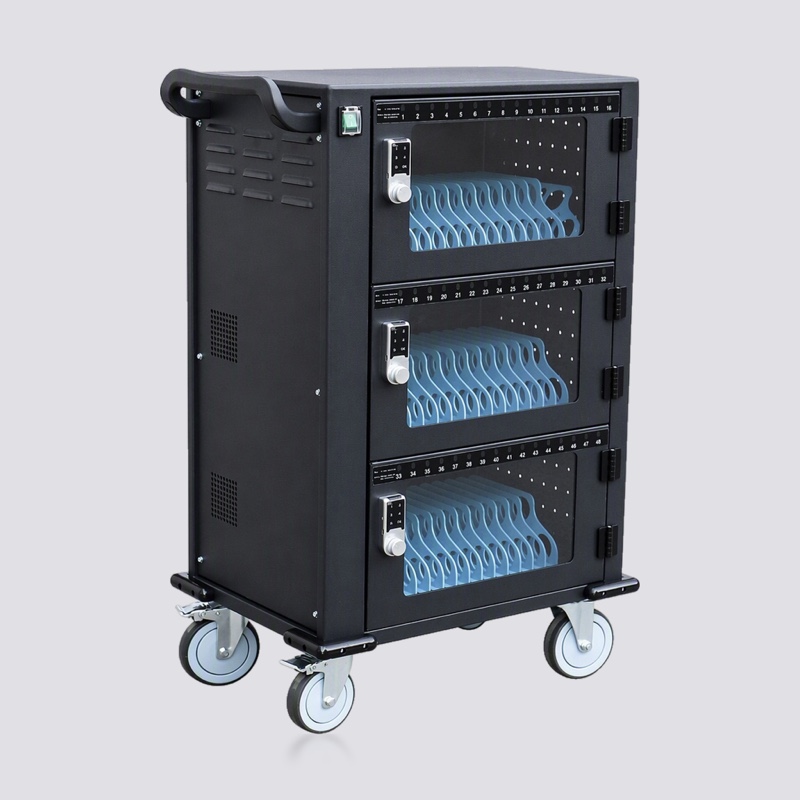
A tablet charging cabinet for schools usually leaves the factory in one of three electrical shapes: AC sockets per bay, USB ports per bay, or a mixed layout. The plug decision interacts with all three, because the cabinet's total draw sets the inlet rating and the cord gauge. A 30-bay AC unit with 65 W adapters can pull close to 2 kW, which is above what a 10 A inlet should carry continuously at 120 V.
The workable pattern is a platform with two inlet options: a 10 A C14 inlet for cabinets up to roughly 1.5 kW, and a 16 A inlet or a dual-feed arrangement above that. The school site then sees one cord and one socket, while the factory keeps one chassis and one harness drawing. A tablet charging cabinet built this way ships as one model with four packing variants, which is also how the spare-part list stays short.
Cord sets and spare parts
Cord sets are consumables in a school. They get trapped under casters, borrowed for other equipment and lost during room moves. A supplier who can ship a spare cord set with the original order, priced as a line item rather than a special request, saves the site a procurement cycle later. Ask for the part number of the cord set per market, not just the product code of the cabinet.
Confirm the cord length: 1.8 m and 3 m cover most classroom layouts, but a 3 m cord changes the packaging.
Confirm the fuse rating on BS 1363 plugs, which must match the cabinet's rated current.
Confirm whether the cord set is packed inside the cabinet or in a separate bag in the carton.
Confirm whether the tablet charging cabinet ships with one spare cord set in the carton, and at what price.
Power Budget at 120 V and 230 V in a USB C Tablet Charging Cabinet
Why the US order needs a different circuit plan
A USB C tablet charging cabinet rated at 45 W per bay behaves very differently on the two mains voltages. The wattage stays the same; the current doubles at 120 V, and current is what trips breakers. The table below uses a 45 W per-bay assumption and a simple watts divided by volts calculation, ignoring efficiency losses of a few percent.
| Cabinet size | Load at 45 W | Current at 120 V | Current at 230 V |
|---|---|---|---|
| 16 bays | 720 W | 6.0 A | 3.1 A |
| 24 bays | 1,080 W | 9.0 A | 4.7 A |
| 30 bays | 1,350 W | 11.3 A | 5.9 A |
| 40 bays | 1,800 W | 15.0 A | 7.8 A |
In North America a 15 A branch circuit is normally limited to 12 A of continuous load, so a 30-bay unit at full draw sits at the edge of a dedicated circuit and a 40-bay unit exceeds it. In the EU, UK and Australia the same cabinets run on a 10 A or 13 A circuit with room to spare. The practical consequence is that the US order should ship with sequenced bank start-up and per-bank current limiting, while the 230 V order can tolerate a simpler distribution board.
This is the argument for quoting the power architecture and the plug together. A buyer who specifies only the socket type can end up with a cabinet that is correctly plugged in and still cannot run a full class set at 08:00. For a 40-bay tablet charging cabinet, the difference between a 120 V site and a 230 V site is simply whether one circuit is enough or two are needed.
What Stays the Same in Every Tablet Charging Cabinet Build
The platform argument
Four plug standards do not require four products. A tablet charging cabinet is built around a chassis, a divider set, a power board and a door, and none of those change when the destination changes. What changes is the inlet module, the cord set, the fuse and the label, which together account for a small share of the bill of materials.
A supplier who quotes four separate models for four markets is usually quoting four separate production runs. A single tablet charging cabinet platform with four localized packing variants keeps tooling amortized, keeps the spare-part list short, and lets a distributor hold one sample instead of four.
How to Vet a Manufacturer Before the First Order
Questions that produce evidence, not adjectives
Most suppliers answer a plug question with a plug type. A manufacturer answers with a build sheet. The difference is worth testing before a sample is booked, because a build sheet can be checked against a customs entry and a school inspection, while an adjective cannot. Ask for the build sheet of the exact tablet charging cabinet on the order, not of the series it belongs to.
| Check | What to ask for |
|---|---|
| Socket standard | Named standard per market, not a photo of a plug |
| Inlet type | Inlet model, rating and whether the cord set is detachable |
| Label | Sample rating label showing voltage, current, frequency and importer field |
| Certification | Test report naming the cabinet model and the destination standard |
| Spares | Part number and price for cord sets, fuses and inlet modules |
For buyers who need the same platform across several markets, Lucktech Group builds tablet charging cabinet ranges on shared tooling with localized inlet, cord set, plug standard and label, so one chassis can serve a US tender and an EU distribution order without a second mold.
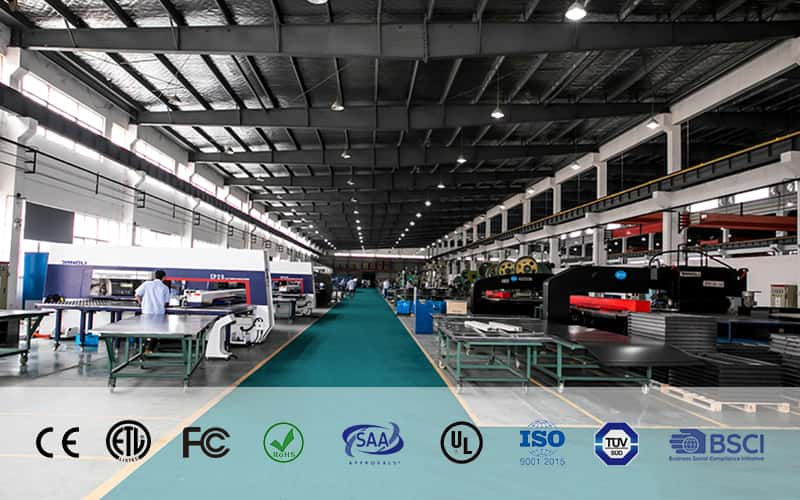
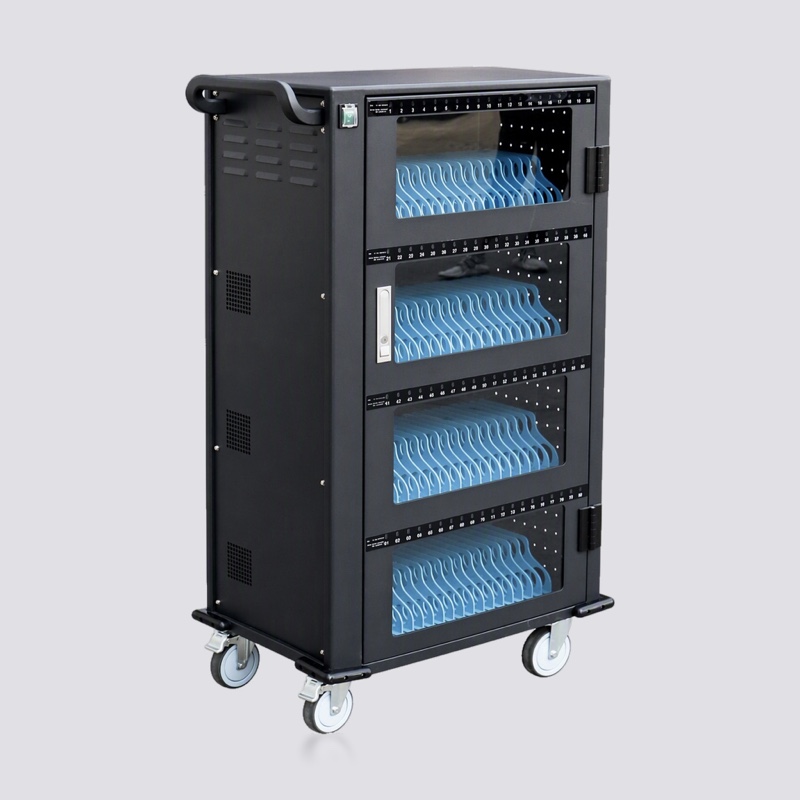
C Series 80-Slot Tablet Charging Cart
Four-tier storage with independent electronic locks, 5 V 2.1 A USB-A output per bay and a heavy steel body, built for school fleets.
View Product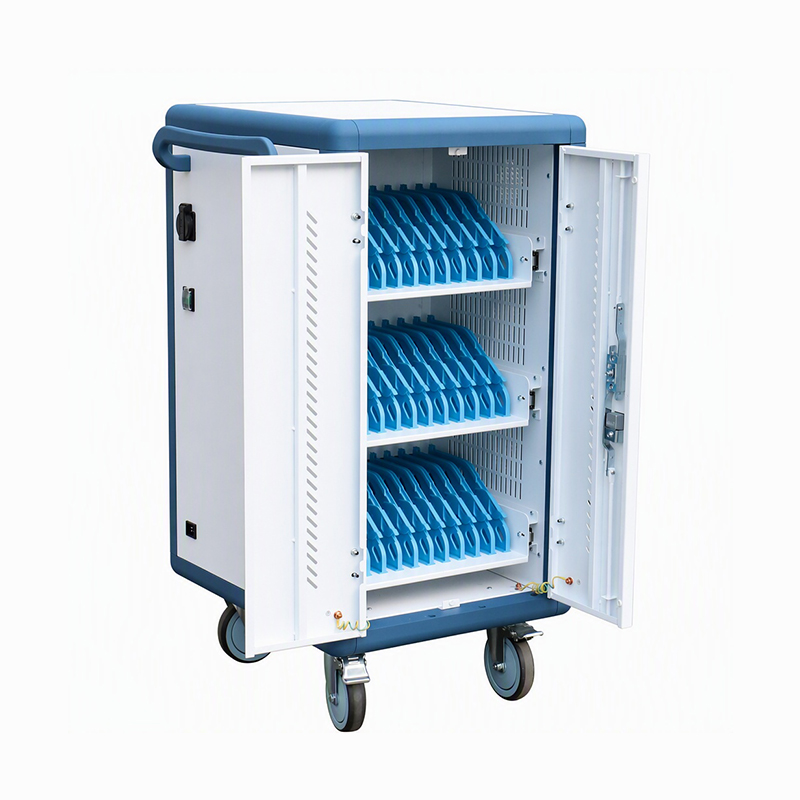
B Series 32-Slot Storage Cart
Sixteen bays across two tiers with 65 W charging and a single lockable steel door, sized for one classroom set plus spares.
View ProductConclusion
The plug is the last item on the specification sheet and the first item an inspector checks. A tablet charging cabinet has to satisfy an electrician, an inspector and a teacher in the same week, and the plug standard is where those three expectations meet. Buyers who treat socket standard, voltage, inlet rating and certification as one decision end up with cabinets that work on arrival; buyers who treat them as a packing detail end up buying cords twice and explaining a delay to a school board.
If you are looking for a reliable tablet charging cabinet manufacturer that supports US, EU, UK and AU plug standards on one platform, choose Lucktech Group. Send the destination markets, the bay count and the device wattage, and request the build matrix before the quotation.
Figures in this article are typical industry ranges compiled from public standards and general market practice, and may vary by model, configuration and destination regulation. Confirm final ratings against the delivered product label.
Need a cabinet that plugs in on the first day?
Tell us the countries, the bay count and the device mix. You will get a per-market build sheet with socket standard, inlet, cord set, marking and lead time.
Request PricingExplore Charging CabinetsFAQ
Can one tablet charging cabinet be converted from EU to UK plugs later?
Usually yes, if the cabinet uses a detachable IEC C14 cord set and a localized label. The cord set and fuse change, the chassis does not. Confirm with the factory that the inlet module is not riveted or potted, and order the spare cord set with the original shipment.
Does a 230 V cabinet work on 120 V mains?
Only if the power supply is rated for both, which most switch-mode supplies in this category are. Current roughly doubles at 120 V for the same wattage, so the circuit plan and the inlet rating have to be checked rather than assumed.
Which certificate does a US school district normally ask for?
A UL or ETL listing to UL 62368-1, held by the manufacturer and naming the cabinet model. Districts increasingly also ask for a load table and a socket schedule, because the facilities team has to confirm the branch circuit before installation.
How many cord sets should be ordered as spares?
A practical starting point is one spare cord set per ten cabinets, plus one inlet module per twenty. Cord sets are lost, trapped under casters and borrowed for other equipment, which is why they dominate the replacement history of any tablet charging cabinet in service.
Does Lucktech supply the same cabinet with different plug standards?
Yes. Lucktech Group builds tablet charging cabinet ranges on shared tooling and localizes the inlet, cord set, plug standard, rating label and documentation per destination market, with certification support for CE, UKCA, RCM and UL-aligned designs.
Recent News
1.How to Choose a Tablet Charging Cabinet Manufacturer for Wholesale
2026-10-142.Wholesale Tablet Charging Cabinet for Schools – 30 / 36 / 48 / 64 / 80 Bay OEM Manufacturer
2026-10-193.AC/USB-A/USB-C Tablet Charging Cabinet – OEM Specs for Channel Brands
2026-11-094.How to choose school tablet charging cabinet supplier?
2026-11-065.China Tablet Charging Cabinet Factory with Low MOQ for Distributors
2026-11-27